JustCTF 2025 Writeup
Challenge Directory
Challenge Name: baby-goes-re
Before we begin, I just wanted to admire the layout of the JustCTF website - it’s really well done and looks super clean! Guess this may be a little biased, since JustCTF 2019 was the first CTF I ever did, and it left a lasting impression on me for a “typical” Jeopardy CTF layout.

Anyway, here’s the chall’s description:
do you like golang? Maybe you’ll like reving it :) good luck!
I have never done anything seriously with Golang before, and thought this would be a great opportunity to learn more about it.
After the description, we are given an ELF binary to analyze. Running file on it gives:
baby-goes-re: ELF 64-bit LSB executable, x86-64, version 1 (SYSV), statically linked, BuildID[sha1]=d5a5f939e1de4a13f2ea0bd4a47b8ebc9f9fb998, with debug_info, not stripped
It was statically linked, which makes its size larger, but as it is not stripped, it does contain debug symbols, which is nice.
Opening it in IDA, we can see the various functions defined in the binary:
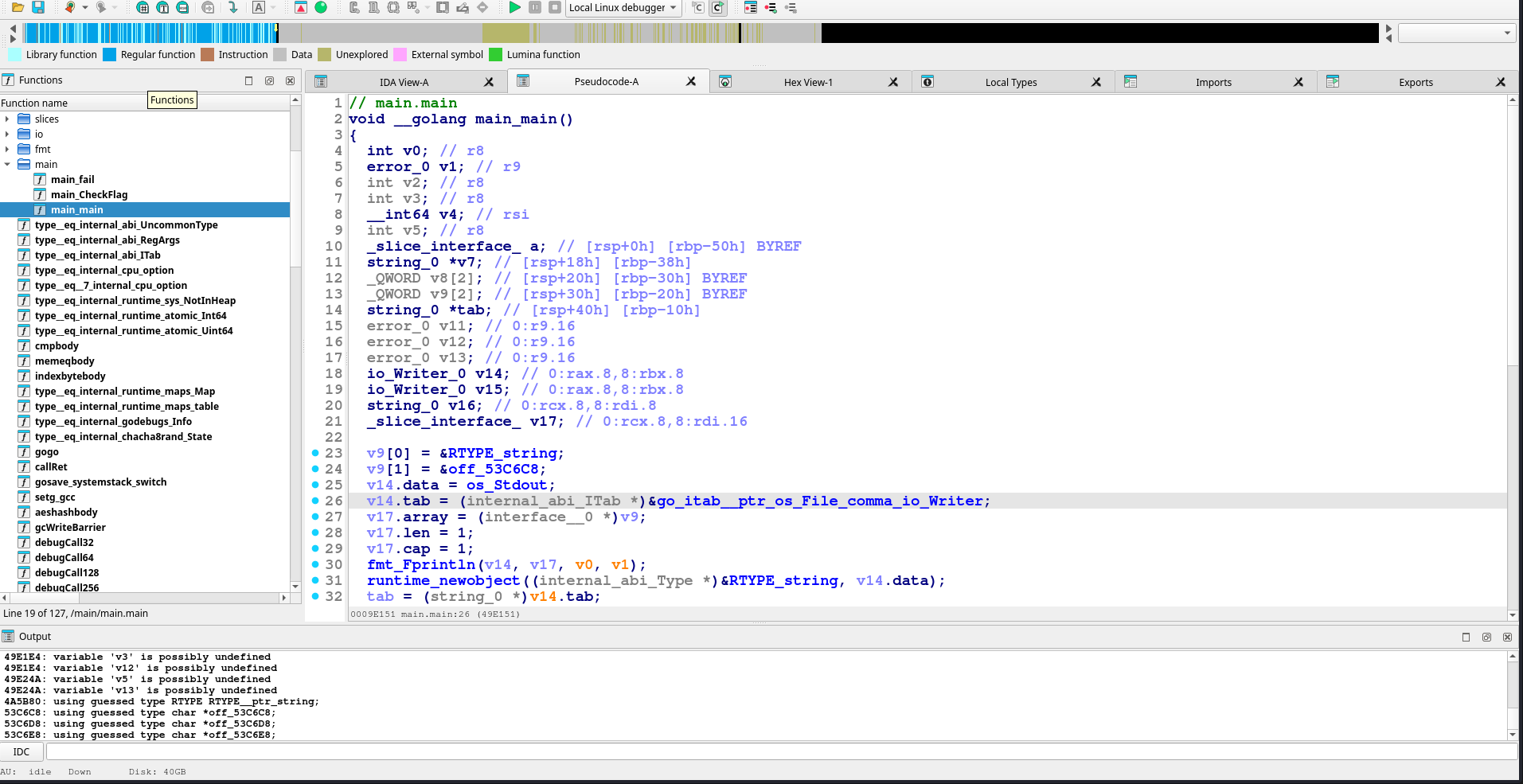
I have the Pseudo code view enabled, which makes it a little easier to understand. The main.main function is where the program starts executing, and in the function definition, we can see __golang, indicating that this is indeed a Golang binary.
We can also see a main.CheckFlag and main.fail functions clearly defined, which are named nicely thanks to the debug symbols from the binary not being stripped.
Since they are fairly small functions, I’ll have the actual decompilation here:
// main.main
void __golang main_main()
{
  int v0; // r8
  error_0 v1; // r9
  int v2; // r8
  int v3; // r8
  __int64 v4; // rsi
  int v5; // r8
  _slice_interface_ a; // [rsp+0h] [rbp-50h] BYREF
  string_0 *v7; // [rsp+18h] [rbp-38h]
  _QWORD v8[2]; // [rsp+20h] [rbp-30h] BYREF
  _QWORD v9[2]; // [rsp+30h] [rbp-20h] BYREF
  string_0 *tab; // [rsp+40h] [rbp-10h]
  error_0 v11; // 0:r9.16
  error_0 v12; // 0:r9.16
  error_0 v13; // 0:r9.16
  io_Writer_0 v14; // 0:rax.8,8:rbx.8
  io_Writer_0 v15; // 0:rax.8,8:rbx.8
  string_0 v16; // 0:rcx.8,8:rdi.8
  _slice_interface_ v17; // 0:rcx.8,8:rdi.16

  v9[0] = &RTYPE_string;
  v9[1] = &off_53C6C8;
  v14.data = os_Stdout;
  v14.tab = (internal_abi_ITab *)&go_itab__ptr_os_File_comma_io_Writer;
  v17.array = (interface__0 *)v9;
  v17.len = 1;
  v17.cap = 1;
  fmt_Fprintln(v14, v17, v0, v1);
  runtime_newobject((internal_abi_Type *)&RTYPE_string, v14.data);
  tab = (string_0 *)v14.tab;
  v8[0] = &RTYPE_string;
  v8[1] = &off_53C6D8;
  v14.data = os_Stdout;
  v14.tab = (internal_abi_ITab *)&go_itab__ptr_os_File_comma_io_Writer;
  v17.array = (interface__0 *)v8;
  v17.len = 1;
  v17.cap = 1;
  fmt_Fprint(v14, v17, v2, v11);
  a.cap = (int)&RTYPE__ptr_string;
  v7 = tab;
  v14.data = os_Stdin;
  v14.tab = (internal_abi_ITab *)&go_itab__ptr_os_File_comma_io_Reader;
  v17.array = (interface__0 *)&a.cap;
  v17.len = 1;
  v17.cap = 1;
  fmt_Fscanln(v14, v17, v3, v12);
  if ( tab->len != 53 )
    main_fail();
  v16.str = (uint8 *)"g9EPa:K5_C:BK[Dr*Z-).*y}Qn}_EA}O&;jM--}L)1fY1@xasr-<g@0!BXc,cnH]vA=7";
  v16.len = 338660;
  main_CheckFlag(*tab, v16);
  a.array = (interface__0 *)&RTYPE_string;
  a.len = (int)&off_53C6E8;
  v15.data = os_Stdout;
  v15.tab = (internal_abi_ITab *)&go_itab__ptr_os_File_comma_io_Writer;
  v16.str = (uint8 *)&a;
  v16.len = 1;
  v4 = 1;
  fmt_Fprint(v15, *(_slice_interface_ *)&v16.str, v5, v13);
}
From this, we can see that the program first prints some text to the user, then reads input from standard input (stdin) into a variable called tab. It then checks if the length of the input is 53 characters, and if not, it calls the main.fail function, which likely terminates the program or indicates failure.
we can see this happening here:
// check fail
  if ( tab->len != 53 )
    main_fail();
and
// check passed
  v16.str = (uint8 *)"g9EPa:K5_C:BK[Dr*Z-).*y}Qn}_EA}O&;jM--}L)1fY1@xasr-<g@0!BXc,cnH]vA=7";
  v16.len = 338660;
  main_CheckFlag(*tab, v16);
When running the binary, when we use an input of incorrect length, we get:
$ ./baby-goes-re
we told the baby what the flag is, so you can just tell ask him and get the easy flag!
Type the information to be read out loud to the baby: test
*baby goes*: REEEEEEEEEEEE
panic: what have you done?! the baby is crying!

goroutine 1 [running]:
main.fail()
        /mnt/c/Users/tomek/ctf/justctf-2025-teaser/challenges/re_baby_goes_re/privates-src/main.go:13 +0x59
main.main()
        /mnt/c/Users/tomek/ctf/justctf-2025-teaser/challenges/re_baby_goes_re/privates-src/main.go:36 +0xda
If we provide an input of the correct length (53 characters), the function main.CheckFlag is called with the user input and a hardcoded string.:
$ ./baby-goes-re
we told the baby what the flag is, so you can just tell ask him and get the easy flag!
Type the information to be read out loud to the baby: 12345678901234567890123456789012345678901234567890123
*baby goes*: REEEEEEEEEEEE
panic: what have you done?! the baby is crying!

goroutine 1 [running]:
main.fail()
        /mnt/c/Users/tomek/ctf/justctf-2025-teaser/challenges/re_baby_goes_re/privates-src/main.go:13 +0x59
main.CheckFlag({0xc000184040, 0x35}, {0x4cb6d5, 0x52ae4})
        /mnt/c/Users/tomek/ctf/justctf-2025-teaser/challenges/re_baby_goes_re/privates-src/main.go:24 +0x12d
main.main()
        /mnt/c/Users/tomek/ctf/justctf-2025-teaser/challenges/re_baby_goes_re/privates-src/main.go:38 +0xf7
I then tried to find the string that is hardcoded in the binary, the one that is passed as the second argument to main.CheckFlag. In the decompilation of main.main, we can see it clearly:
  v16.str = (uint8 *)"g9EPa:K5_C:BK[Dr*Z-).*y}Qn}_EA}O&;jM--}L)1fY1@xasr-<g@0!BXc,cnH]vA=7";
  v16.len = 338660;
  main_CheckFlag(*tab, v16);
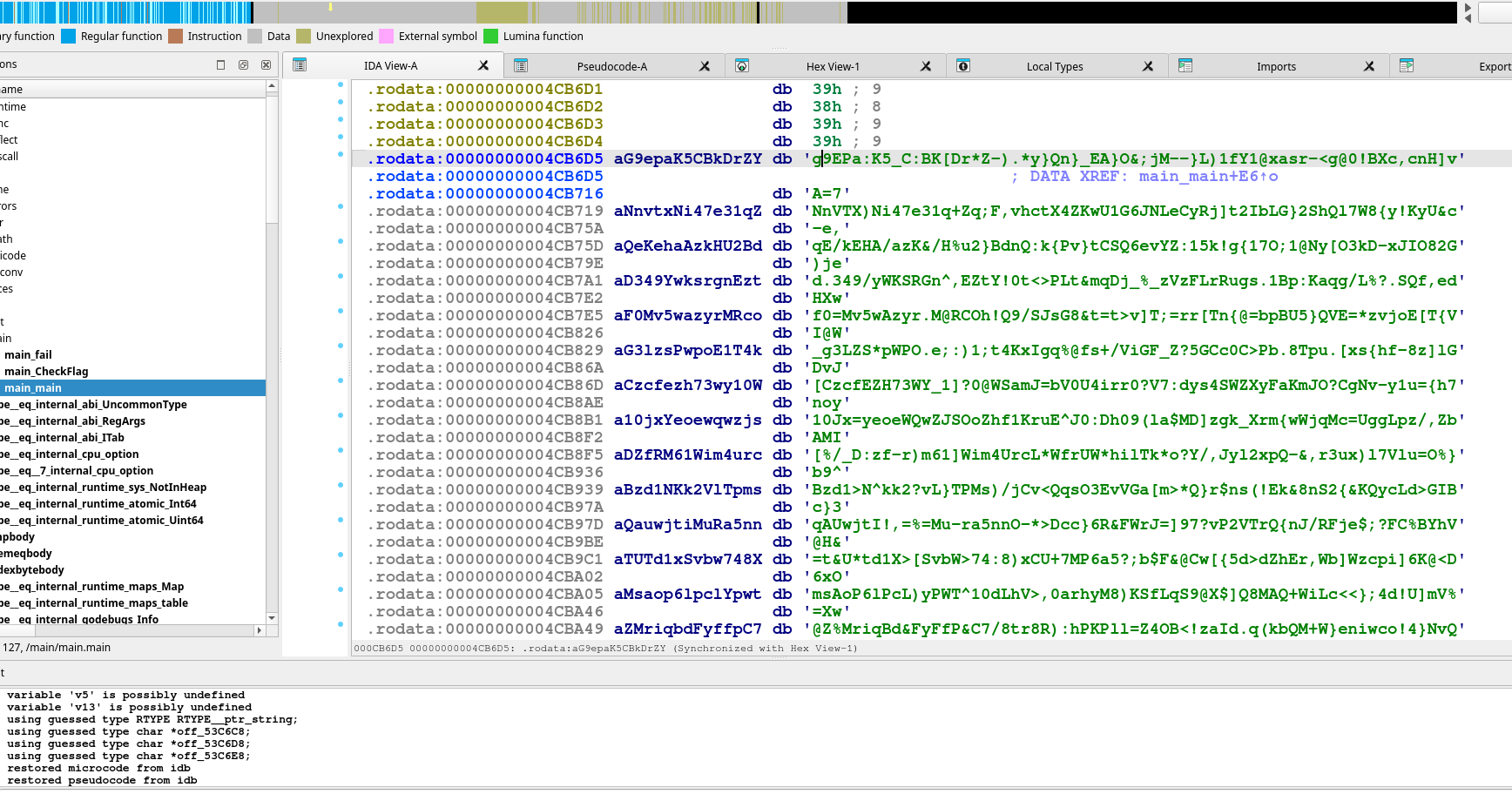
But IDA only shows a part of it, with the larger string probably being 338660 bytes long (as indicated by v16.len = 338660). Double clicking on the string in IDA takes us to its location in the binary in the .rodata section, where we can see all of it starting from the offset 0x4CB6D5 till 0x51E1A2:
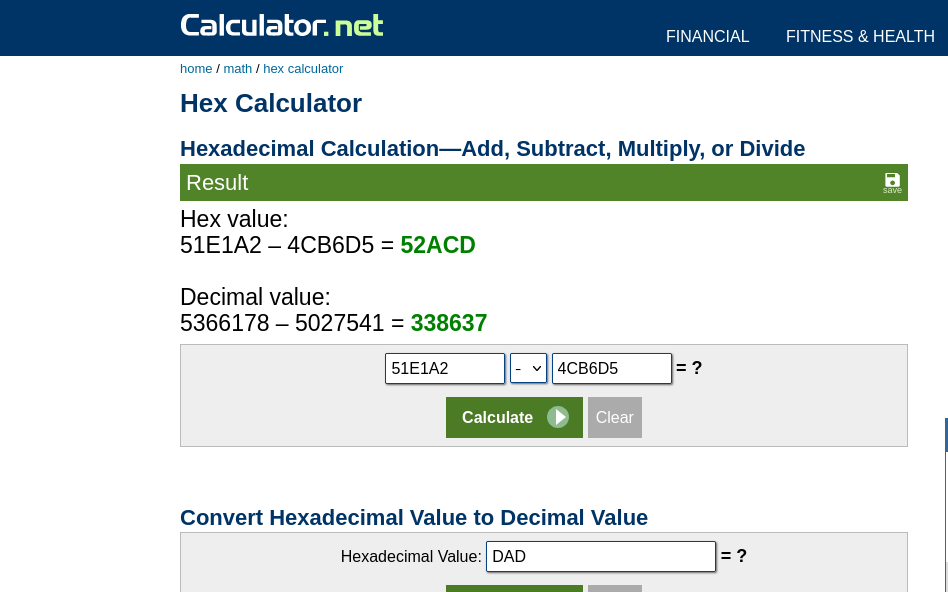
Using a hex calculator, subtracting the two adresses gives us the length of the string as 0x52ACD bytes, which is 338637 in decimal, very close to the 338660 value we saw earlier (even though it wasn’t exact, it fortunately didn’t matter to get the flag).
I tried exporting this entire section as a string literal using IDA’s “Export string literal” feature, but IDA complained that it was too large. So I exported it as an unspaced hex string instead, which I planned to deal with later.
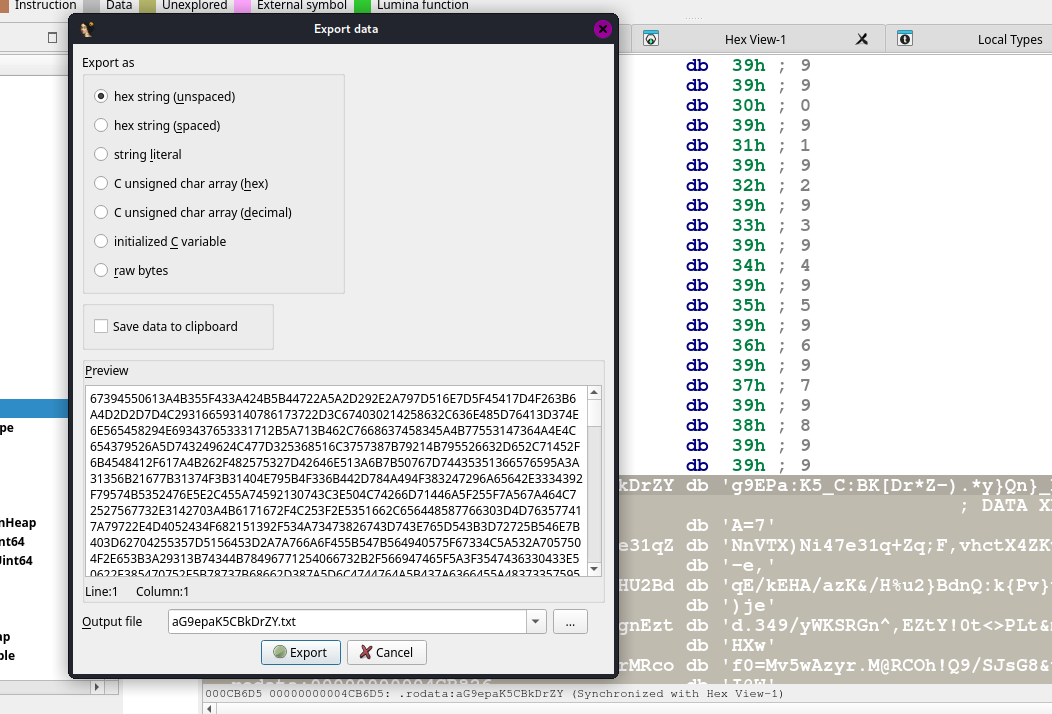
I know that I could have just used other tools like xxd or hexdump to extract the string from the binary, but at the time this was what I went with!
Let’s check out the other functions, starting with main.fail:
// main.fail
void __golang __noreturn main_fail()
{
  int v0; // r8
  error_0 v1; // r9
  _slice_interface_ a; // [rsp+0h] [rbp-18h] BYREF
  io_Writer_0 v3; // 0:rax.8,8:rbx.8
  _slice_interface_ v4; // 0:rcx.8,8:rdi.16

  a.array = (interface__0 *)&RTYPE_string;
  a.len = (int)&off_53C6A8;
  v3.data = os_Stdout;
  v3.tab = (internal_abi_ITab *)&go_itab__ptr_os_File_comma_io_Writer;
  v4.array = (interface__0 *)&a;
  v4.len = 1;
  v4.cap = 1;
  fmt_Fprintln(v3, v4, v0, v1);
  v3.tab = (internal_abi_ITab *)&RTYPE_string;
  v3.data = &off_53C6B8;
  runtime_gopanic((interface__0)v3);
}
This function prints a message to standard output and then calls runtime_gopanic, which causes the program to panic and terminate. This is consistent with our observation that when the input length is incorrect, the program panics.
Now, let’s look at the main.CheckFlag function:
// main.CheckFlag
void __golang main_CheckFlag(string_0 flag, string_0 babymemory)
{
  int count; // rdx
  int v3; // rsi
  __int64 v4; // r8
  unsigned int v5; // r9d
  int v6; // rdx
  unsigned int v7; // eax
  unsigned __int64 v8; // r10
  __int64 v9; // r11
  __int64 v10; // rsi
  int64 v11; // rbx
  __int64 v12; // rax
  __int64 v13; // rcx
  __int64 v14; // rbx
  char v15; // al
  uint8 v16[4]; // [rsp+0h] [rbp-3Ch] BYREF
  uint8 buf[4]; // [rsp+4h] [rbp-38h] BYREF
  _DWORD v18[5]; // [rsp+8h] [rbp-34h]
  int64 v19; // [rsp+1Ch] [rbp-20h]
  int v20; // [rsp+24h] [rbp-18h]
  __int64 v21; // [rsp+2Ch] [rbp-10h]
  uint8 *s; // [rsp+44h] [rbp+8h]
  int s_8; // [rsp+4Ch] [rbp+10h]
  uint8 *str; // [rsp+54h] [rbp+18h]
  int len; // [rsp+5Ch] [rbp+20h]

  str = babymemory.str;
  s_8 = flag.len;
  s = flag.str;
  len = babymemory.len;
  count = 0;
  v3 = 0;
  v4 = 0;
  while ( flag.len > count )
  {
    *(_QWORD *)&v18[1] = v4;
    v5 = flag.str[count];
    if ( v5 >= 0x80 )
    {
      *(_QWORD *)&v18[3] = v3;
      runtime_decoderune(flag, count, babymemory.len, v3);
      babymemory.str = str;
      v3 = *(_QWORD *)&v18[3];
      babymemory.len = len;
      v4 = *(_QWORD *)&v18[1];
      v5 = v7;
      v6 = flag.len;
    }
    else
    {
      v6 = count + 1;
    }
    v8 = v4 + v3 + 4919;
    v9 = v4 + v3;
    v10 = v4 + v3 + 4920;
    if ( babymemory.len <= v8 )
      runtime_panicIndex();
    v18[0] = v5;
    *(_QWORD *)&v18[3] = v10;
    v20 = v6;
    v11 = babymemory.str[v9 + 4919];
    runtime_intstring((uint8 (*)[4])buf, v11, babymemory);
    v19 = v11;
    v21 = v12;
    v13 = v18[0];
    v14 = v18[0];
    runtime_intstring((uint8 (*)[4])v16, v18[0], babymemory);
    if ( v19 != v14 || (runtime_memequal(), !v15) )
      main_fail();
    v4 = *(_QWORD *)&v18[1] + 51LL;
    flag.str = s;
    babymemory.len = len;
    flag.len = s_8;
    babymemory.str = str;
    v3 = *(_QWORD *)&v18[3];
    count = v20;
  }
}
This function takes two string arguments: flag (the user input) and babymemory (the hardcoded string). It iterates over each character in the flag string, performing some operations that involve checking against the babymemory string. If any check fails, it calls the same main.fail function, causing the program to panic again.
The key part of the logic seems to be this:
    v11 = babymemory.str[v9 + 4919];
    runtime_intstring((uint8 (*)[4])buf, v11, babymemory);
    v19 = v11;
    v21 = v12;
    v13 = v18[0];
    v14 = v18[0];
    runtime_intstring((uint8 (*)[4])v16, v18[0], babymemory);
    if ( v19 != v14 || (runtime_memequal(), !v15) )
      main_fail();
Here, it retrieves a character from the babymemory string at an offset of v9 + 4919, processes it with runtime_intstring, and compares it to a similarly processed value from the flag string. If they don’t match, it calls main.fail.
To emulate this logic and get the correct values for v9, v11, etc, I wrote a Python script to extract the flag by reversing the logic in main.CheckFlag. Since a lot of the variables were a bit confusing to track, I simplified the logic to just focus on the key parts needed to extract the flag, combining duplicate variables in the process:
# flagExt.py
# Constants from the reverse-engineered code
FLAG_LENGTH = 53
BASE_OFFSET = 4919
V4_STRIDE = 51 # 51LL
V3_ADD = 4920

def extractFlag(babymemory):
    flagChars = []


    v3 = 0
    v4 = 0

    for i in range(FLAG_LENGTH):
        index = v4 + v3 + BASE_OFFSET

        if index >= len(babymemory):
            print(f"\nError: Data blob is too short to find character {i+1} at index {index}.")
            return None

        # Append the character at the calculated index
        flagChars.append(chr(babymemory[index]))


        # This mimics the logic found in the binary to update states for the next iter
        next_v3 = v4 + v3 + V3_ADD # v3 is updated to previous v4 + previous v3 + 4920
        next_v4 = v4 + V4_STRIDE # v4 is updated to previous v4 + 51

        v3 = next_v3
        v4 = next_v4

    return "".join(flagChars)

if __name__ == "__main__":
    inputFilename = input("Enter the filename of the blob containing the extracted hex data: ")
    try:
        with open(inputFilename, "r") as f:
            hexString = f.read()

        cleanedHex = "".join(hexString.split())
        babymemory = bytes.fromhex(cleanedHex)

        # Debug: Print the length of the read data
        print(f"Read and decoded {len(babymemory)} bytes from {inputFilename}.")


        flag = extractFlag(babymemory)

        if flag:
            print("flag found!")
            print(flag)

    except FileNotFoundError:
        print(f"Error: '{inputFilename}' not found.")
    except ValueError:
        print("Error: The file contains non-hex chars.")
running this script with the extracted hex data from earlier gives us the flag!!!!
$ python flagExt.py
Enter the filename of the blob containing the extracted hex data: babymem.txt
Read and decoded 338773 bytes from babymem.txt.
flag found!
justCTF{W3lc0m3_t0_R3v1NG!_Th4t_w45nt-s0-B4d-w45_1t?}
Wooooo! Go is no different from C/C++ when it comes to reverse engineering, and the concepts are largely the same. The main difference is just understanding the Golang runtime functions and how they operate, but once you get the hang of it, it’s pretty straightforward. I found it quite funny how the reverse engineered / decompiled code is still in C, even though the original source code was in Go!
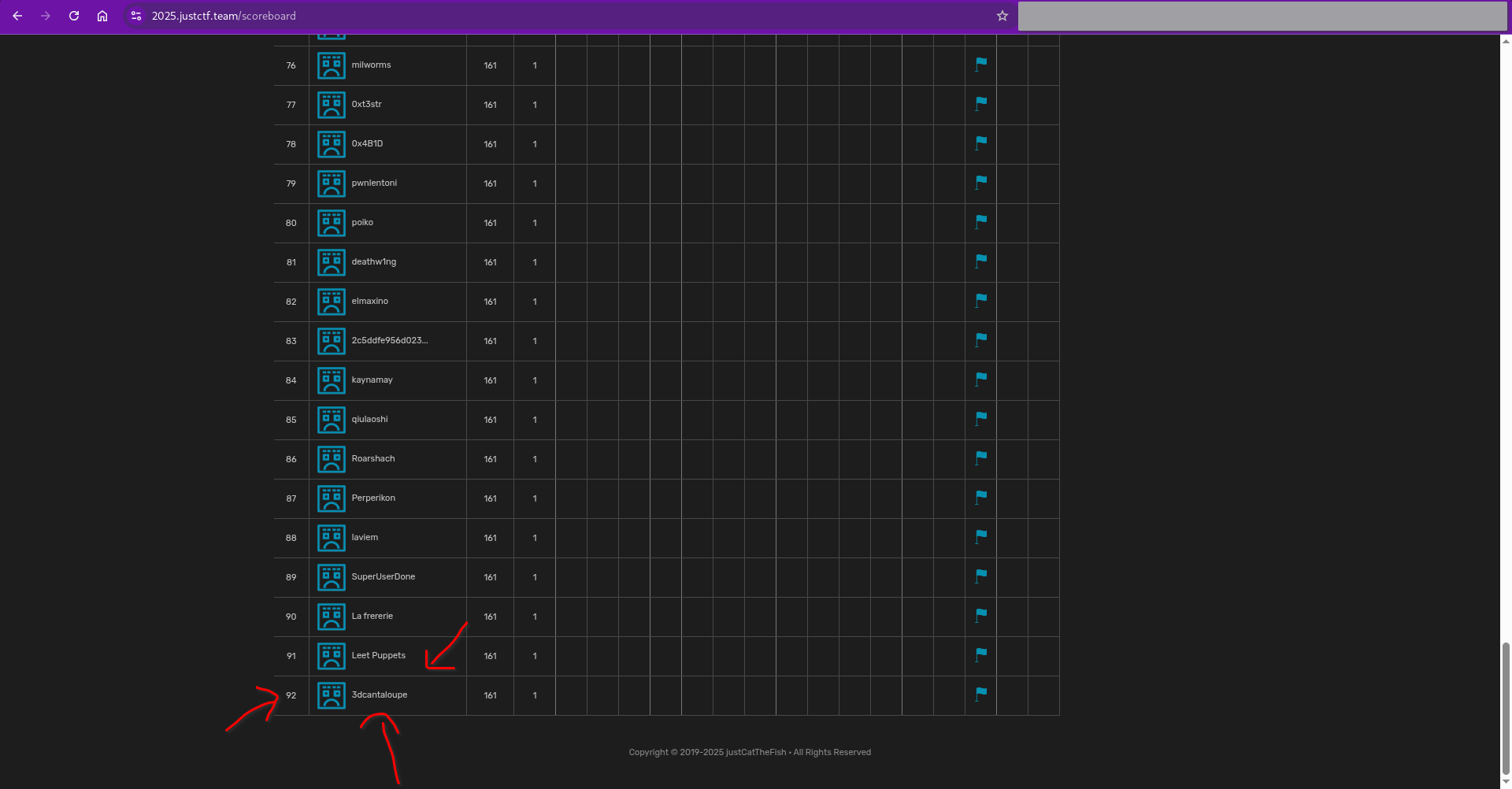
My regular CTF team was doing a diffrent CTF that weekend, so I did this CTF solo, and here’s me on the scoreboard!!